

Every app can tell you what helps. This one tells you what helped you.
Talk through whatever is on your mind. Tell Melyvi how you want to be met, and it listens that way. When talking is not enough, it offers a short exercise built from WHO and NHS guidance and checked by a clinician. The next day it asks if that helped, and saves your answer. Months later it can show you what actually worked for you — and every time you tried it.
iPhoneAndroid— not released yet. The waitlist is how you hear first.
Free to start · Not therapy or a diagnosis · Memory is on from day one, and yours to pause · Adults 18+
The same sentence, said to two apps.
“She hasn’t replied for six hours and I’m getting really anxious.”
Explains anxiety. Correctly, probably. To a stranger it knows nothing about.
“You described something very like this after two earlier situations, and both times the not-knowing seemed to land harder than a clear answer — is that what’s happening again?”
Melyvi can only say that because it saved two earlier moments, each tied to the words you used at the time. Two moments make a pattern. One never does.

Nothing saved. Next to a history built one conversation at a time.
Not what helps. What helped you.
Any assistant can tell you walking is good for anxiety. None can tell you whether it worked for you last month, because none of them wrote it down. Melyvi keeps the record: what you tried, when, and how it went — and if you never said how it went, it asks.
Yesterday you tried walking after dark. It has helped 5 of 7 times before.
Did it help?
“Too early to say”
One or two tries is not a pattern, so Melyvi will not call it one.
“Has seemed to help”
Worth noticing. Not enough to put a number on.
“You reported it helped 5 of 7 times”
The real count, in your words. Tap to open all seven.
Once there is enough to look at, the same record answers a sharper question: when it helped and when it did not, sorted by what set the evening off and how you felt. Anything resting on fewer than two separate moments is not shown at all.
Your answer wins
One tap settles it. Melyvi saves what you said, and nothing it guessed can overwrite that.
Skipping costs nothing
Only the tries you answered for are counted. Leave a question alone and it stays out of the maths — it never quietly counts as a failure.
It asks once
One question the next day. One tap to answer, one to wave it away, and either way it never comes back. Nothing older than a week is raised at all.
Where this stops: these are your own answers, counted. A count shows what happened together, never what caused what, and nothing here says Melyvi treats anything. It is your record, added up and handed back.
Most apps are built for everything. This one is built for one thing.
Melyvi is not a therapist and does not diagnose. It is a wellbeing app for adults, built for one kind of conversation and nothing else — which is what makes the rest of this table possible.
| A general AI assistantBuilt for everything | A journalling appBuilt to hold your words | An AI friend or character appBuilt to be company | MelyviBuilt for one thing | |
|---|---|---|---|---|
| What it is for | Code, email, holidays, homework. A hard evening is one job among thousands. | Keeping what you wrote. It does not answer you. | Company. And staying in character while it keeps you company. | Working out what is on your mind. There is nothing else in the app. |
| What it remembers about you | Enough to be handy on any subject you bring it. | Exactly what you typed, filed by date. Nothing is joined up for you. | Enough to sound like it knows you. | The people, moments, feelings, patterns and what actually helped — each one linked back to your own words. |
| Where its suggestions come from | Whatever the model says next. | You. It suggests nothing. | Whatever the model says next, in character. | Six set exercises built from published WHO and NHS guidance. A clinician approves every version. The AI picks one and words it — it cannot make one up. |
| What it can tell you six months in | What helps people in general. It kept no record of what helped you. | Whatever you can find by scrolling back and reading it yourself. | What it has picked up about you, in character. Nothing is counted. | How often each thing you tried helped, by your own answers — and, once there is enough, which situations it worked best in. |
| If you say something worrying | It answers as best it can. | Nothing happens. It is a file. | It answers in character. | Your message is checked before the AI ever sees it. An urgent one skips the AI and goes straight to local crisis and emergency numbers. |
Compared by what each kind of app is built to do, not by brand name — features change month to month, purpose rarely does. Melyvi remembers from the first conversation, because that is the point of it — and every line is yours to read, correct, hide or erase. One switch pauses all of it.
Three steps, and then it’s just talking.
Memory is not an add-on. It is on from the first conversation, and it is what lets the second one start somewhere real.

You say how you want to be met. It follows.
Five styles, and you can switch mid-conversation. Each one comes from a known way of sitting with someone — reflective listening, naming the feeling, Socratic questioning, steadying, CBT-style testing. Below is the exact instruction each style gives the AI. Being advised at when you wanted to be heard is a real thing, so we wrote the difference down instead of hoping for it.

“Reflect back what you heard and stay with it. Do not analyse, advise, or reframe. At most one soft invitation to say more.”

“Use emotional labelling and reflective listening to help them name what is happening and why it might be happening.”

“Use Socratic questioning. Follow the thread underneath what they said rather than the surface content.”

“Prioritise emotional regulation. Slow the pace, shorten sentences, orient to the present. No analysis until they are steadier.”

“Use CBT-style questioning to test assumptions and predictions, warmly and without winning the argument.”
Every reply can show why it was said, in one plain sentence — “why I’m asking this” is a button, not a mystery.
Quiet on purpose.
Real exercises, with clear limits.
When talking is not enough on its own, the conversation can open a tool. Melyvi picks an approved exercise and puts it in your words — it cannot make one up. The check-in scores track whether anything is changing; they do not diagnose. You choose every exercise, every action and every share.

Orient to the present
2–4 minutesCut the overwhelm enough to pick a next step.

Slow the pace
1–3 minutesSlow your breathing when you are too wound up to think.

Facts and predictions
5–10 minutesTell what you actually know apart from what you fear.

Make room for a thought
3–7 minutesStop wrestling a thought you cannot solve right now.

One useful action
Plan in 3 minutesDo one small thing: a routine, a skill, a pleasure, or a person.

Make the problem smaller
5–12 minutesTurn going in circles into one step you can control.
Every use records the exact version you got. A tool that could leave you feeling worse says so before you start, and tells you to stop if it does. Where each one comes from →
PHQ-9 and GAD-7, every 14 days
Spaced out so they never feel like homework. They show whether anything is moving. They are not a diagnosis, and no number decides anything for you.
One small behaviour, not more time in the app
Plan the smallest useful thing, name what might get in the way, keep an easier backup. Afterwards you look at how it felt — not whether you did it right.
Built before a crisis, not during one
Yours to write and yours to change. Crisis numbers load live, so a wrong one gets fixed without waiting for an app update.
A clinician summary you read first
Build a preview, read exactly what is in it, then approve it — or keep it as a preview and send nothing. You can undo the approval later.
Every message and new journal entry is checked first. An urgent one skips the AI completely and goes straight to local crisis and emergency help.
The log keeps what route was taken and which checker ran. Never your words.
Every exercise names its source. So does every measure.
No AI wrote these six tools, and we did not invent them. Each one is a close adaptation of published WHO or NHS self-help guidance, and each one carries its source and what we changed inside the app itself — not just on a marketing page. Here is that record, unedited.
Orient to the present
A short grounding exercise, adapted from WHO's field-tested stress guide.
World Health Organization ↗Make room for a thought
Based on WHO skills for unhooking from a thought and making room for it.
World Health Organization ↗One useful action
Based on WHO skills for acting on what matters to you. Melyvi adds the follow-up question.
World Health Organization ↗Make the problem smaller
A simple problem-solving structure, based on NHS self-help guidance on worry.
NHS ↗Standard clinical questionnaires, not a score we made up
Rules that block a release, not good intentions
Melyvi has not been shown to treat anything, and nobody here will tell you otherwise until a study says so.
Sourcing an exercise well is not proof that a product works. Nor is watching someone’s scores fall — change seen in ordinary use is not proof, and our own governance document says so in those words. The order of work: clinician-reviewed safety testing, a usability study, a real-world pilot, and only then a controlled trial.
That trial is built so it can fail. It pits the full app against the same exercises with the personal conversation and the memory stripped out — so if the memory adds nothing, the trial will show it. Memory then gets a second trial of its own, against plain session summaries.
Messages sent, time in app, attachment and streaks are not clinical targets, and nobody here is measured on them.
Everything it keeps, and where each line came from.
Melyvi keeps only what you actually said, and shows you where every line came from. Read it, correct it, hide it or delete it for good. Anything it worked out on its own is labelled a guess, and stays a guess until you say otherwise.
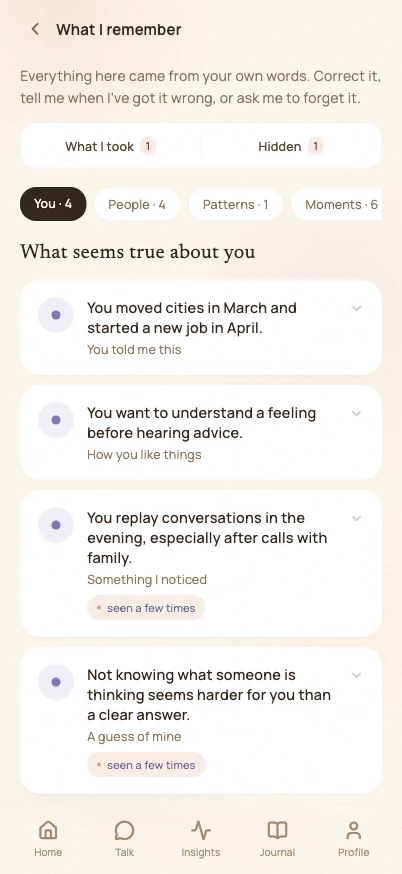


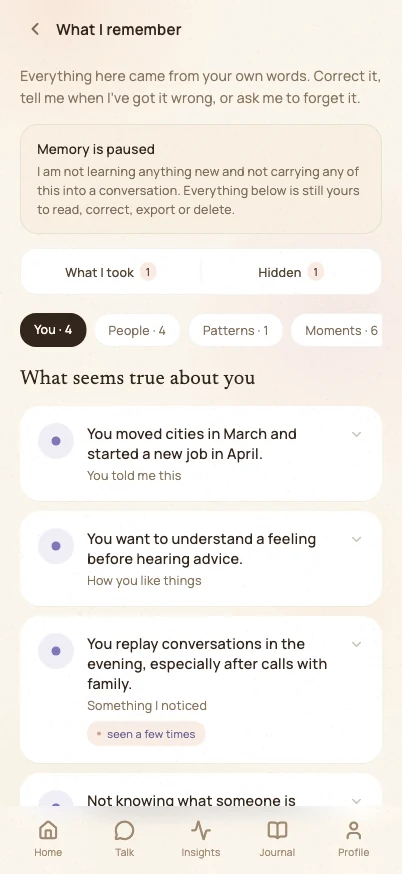
Privacy you can switch off, not just read about.
Melyvi remembers from the first conversation — that is what the app is for, and the first screens explain it before you agree to anything. Turn it off and the conversation, the five styles and the tools all still work; every chat simply starts fresh. Three switches, and each one changes what the app can actually do — not just what it shows you.
Having to re-explain yourself often seems to come before you go quiet.
This line and everything attached to it are deleted. The original conversation stays unless you delete that too.
Nobody is automatically reading your conversations.
Melyvi is an AI tool for thinking things through and guided self-help. It does not diagnose, replace professional care, or watch over you in an emergency. The log records that a safety check ran or a memory was deleted — never what was said.
How care and safety work →Before you sign up.
No, and we are not allowed to market it as one. Melyvi is a wellbeing and self-help app for adults. It does not diagnose, treat or cure anything, and it cannot judge whether you are safe. Plenty of people use it between sessions — it helps you turn up with the words already found.
A general assistant is built for everything. This is built for one kind of conversation. You pick how you want to be met, and the AI gets written instructions for that style instead of defaulting to advice. The self-help tools are six set exercises a clinician approved, not improvised suggestions. Every message is checked for risk before the AI ever sees it. And the memory keeps what this kind of conversation runs on — the people, the moments, the patterns, what helped — with a source on every line.
You get one of six set exercises: grounding, slow breathing, separating facts from fears, making room for a thought, one useful action, or breaking a problem down. A clinician approves every version, and each use records the exact version you got. The AI picks one and puts it in your words — it cannot make one up.
Two honest halves. The content is sourced: all six tools come from published WHO and NHS self-help guidance, each carrying its source inside the app, and the check-ins are PHQ-9, GAD-7 and WHO-5 rather than a score we invented. The product is not yet proven: nobody has run a controlled trial, so Melyvi has not been shown to treat anything. Watching scores fall in ordinary use would not settle it either. The order of work is safety testing, a usability study, a real-world pilot, then a controlled trial that pits the full app against the same exercises without the personal conversation or the memory. If the memory adds nothing, that trial is built to show it.
Yes. Remembering across conversations is on from sign-up, because the whole app is built around it. The first screens explain it before you agree to anything, and that agreement is recorded. You can switch it off in Profile any time: Melyvi stops learning and stops looking anything up, and your profile is dropped from the very next reply, so every chat starts fresh. Switching off deletes nothing you already have, and switching back on does not reach back into the chats you had while it was off. Journal entries stay out of memory until you say otherwise.
Yes — one screen, every item, each one traceable to the exact words it came from. Nothing is remembered without that link, so “why do you think that?” has an answer on every line.
Correct it and your version wins — nothing overwrites a memory you edited by hand. Say “not quite” to a guess and it is dropped and never suggested again. Hide it and Melyvi will not learn it again. Erase it and the line and everything attached to it are deleted.
Sure enough to ask, never sure enough to tell you. Confidence comes from how many separate moments back a pattern up, not from the AI's own opinion: one moment is not a pattern at all, and evidence alone never reaches certainty. Your answer outranks the maths.
Your message is checked before the AI sees it. An urgent one skips the AI completely and goes straight to local crisis and emergency help. Melyvi stays present instead of going cold — and it never pretends a person is watching.
You can build a summary, read exactly what is in it, then approve it — or keep it as a preview and send nothing. You can undo the approval later. Nothing is shared without that step.
You. Ordinary private conversations are not read by anyone. Serious incidents go to a restricted safety review, where who looked, why, how little they saw and what came of it are all logged. Export or delete your conversations whenever you like.
Not yet. Melyvi is in build and is not in the App Store or on Google Play, and there is nothing to sign up to in the meantime. Leave an address on the waitlist and you get one email the day it opens on your platform — that is the whole of it, and you can leave the list from any of it.
Never. Typing and voice do the same thing, and the journal is there for the days you would rather not be asked anything at all.
Be there the day it opens.
Melyvi is still in build — not in the App Store, not on Google Play. Leave an address and you hear once, the day it opens on your platform.
iPhoneAndroid— not released yet. The waitlist is how you hear first.
For adults 18+ · Not therapy, a diagnosis or an emergency service · Memory is on from day one and can be paused any time.